Frankfurt Day Tours
I’m Serious Day Tour Man AI, your day trip expert. Ask me anything — where to go, how to get there, and what’s actually worth your day.
Frankfurt is the day-trip hub the airport built: Heidelberg’s romantic ruin is under an hour, the Rhine’s castle gorge and Rüdesheim’s vineyards are an hour west, Gutenberg’s workshop city is forty minutes, and a Tiepolo-frescoed palace that survived 1945 by luck is seventy minutes east.
The city itself gets underrated by people who never left the fair district: the rebuilt old town raises a fair question answered below, the museum embankment is a heavyweight row, and the apple wine district across the river runs on rules worth learning before the first glass arrives sour and correct.
Here’s what’s worth a day, with real times and honest trade-offs.

Popular Day Trips
Heidelberg
The Easy Train, the Castle Combo Ticket
Rhine Valley
The Train-Boat-Train Loop, the Loreley
Rothenburg
The Two Changes, the Covered Walls
Würzburg
The Tiepolo Ceiling, the Wine on the Bridge
Mainz
Check the Gutenberg Museum’s Status, the Chagall Blue
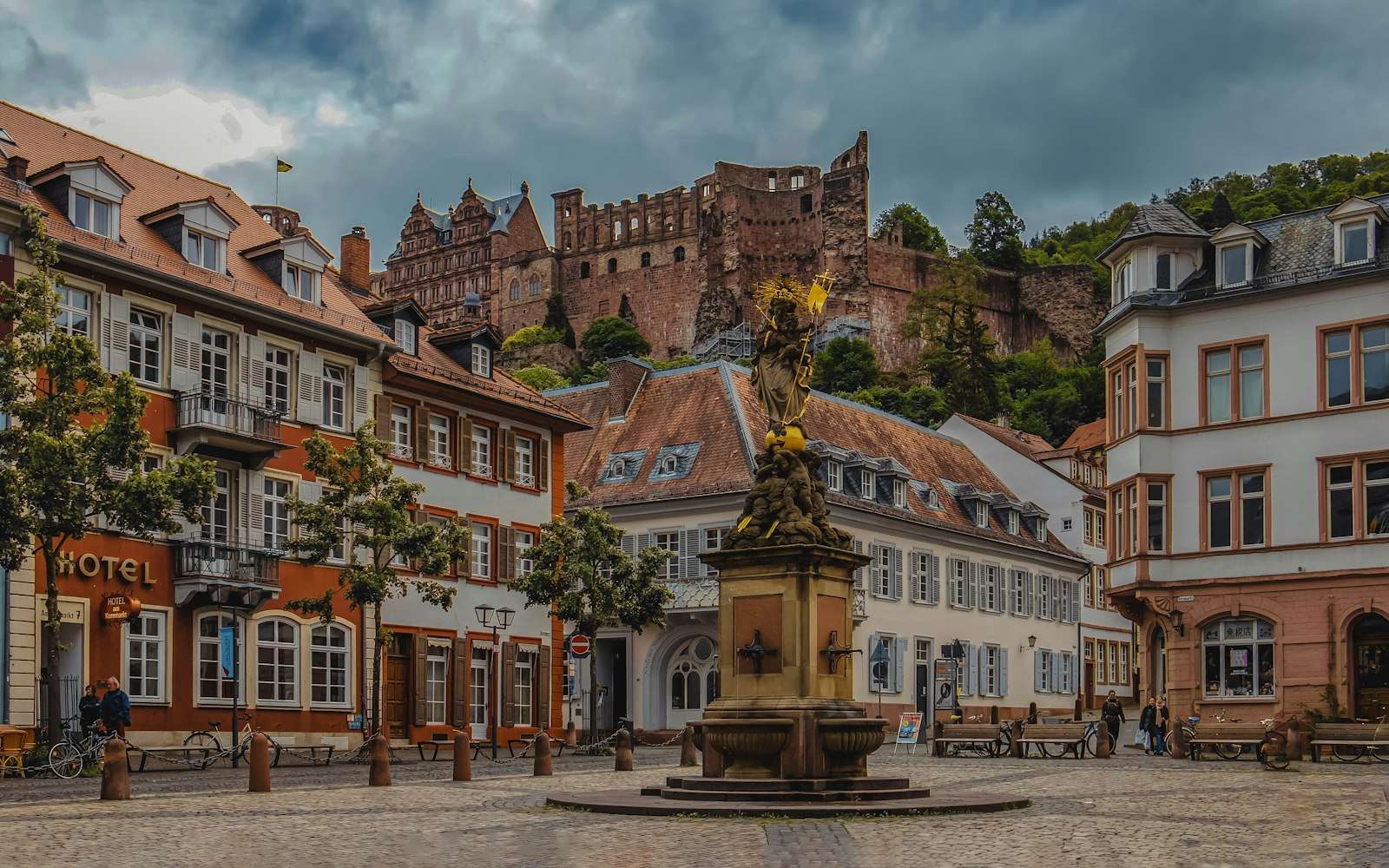
Heidelberg — The Romantic Standard
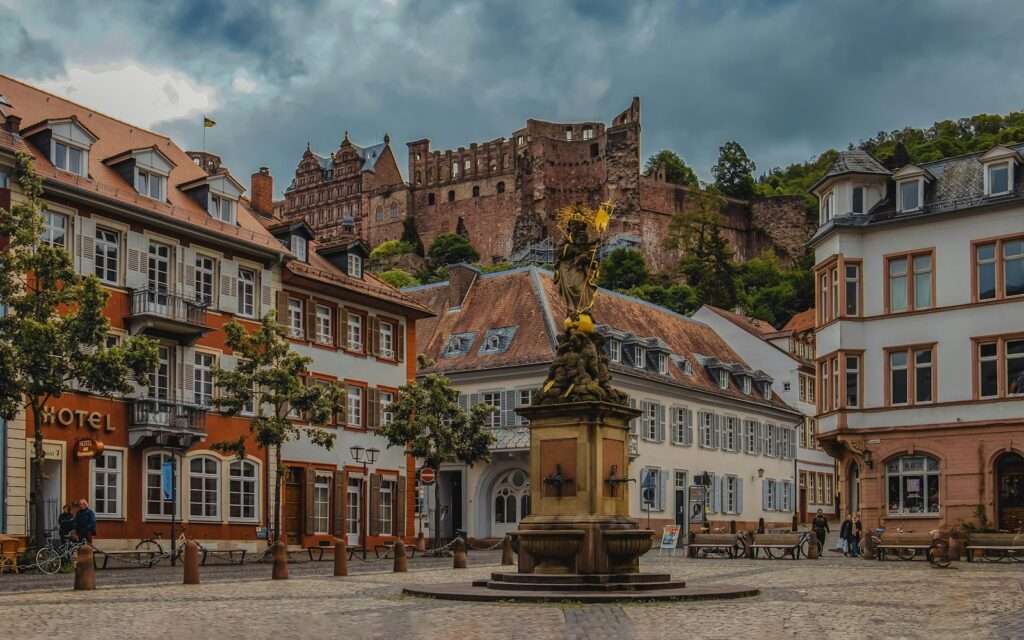
Just under an hour south, Heidelberg is the day trip that invented German romanticism’s postcard: the red sandstone castle ruin above the Neckar, the old bridge, and the view from the Philosophers’ Walk that composed itself for painters two centuries ago.
The castle ticket (about €11) bundles the funicular’s lower section from Kornmarkt, the courtyard, the Great Tun — the absurd 220,000-liter wine barrel with a dance floor on top — and the German Pharmacy Museum. The interiors open only by guided tour, with the last one around 4 p.m., and the upper funicular continues to the Königstuhl summit for the wide view. Buy at the Kornmarkt station or the tourist offices; the official palace site carries current hours.
The circuit below: the Alte Brücke and its brass monkey (touch the mirror, local luck), the Hauptstrasse’s mile-long pedestrian spine, the Studentenkarzer — the university’s graffiti-covered student jail, a genuine oddity — and the Philosophers’ Walk across the river for the classic composition, best in afternoon light. Summer brings the castle illuminations and fireworks on set dates; December brings one of the region’s better Christmas markets. The town runs touristy and is worth it anyway.
Read the full Heidelberg day-trip page.
Rüdesheim & the Rheingau — Wine and the Gorge’s Gate
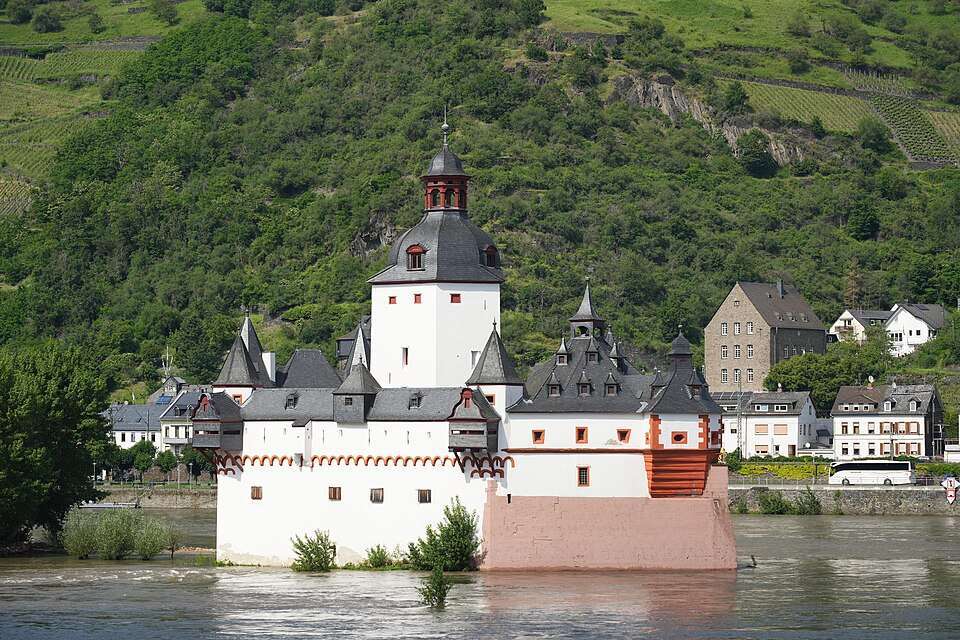
An hour west, Rüdesheim sits where the Rhine turns into its gorge, and the sorting starts with the Drosselgasse: the famous lane is two meters wide, wall-to-wall wine taverns, and purpose-built for coach tourism — see it in ninety seconds, then spend the day on the better material around it.
The better material: the cable car over the vineyards to the Niederwald Monument — Germania at forty meters of nineteenth-century bombast, with the gorge view that justifies everything — then the ring walk or chairlift down to Assmannshausen, the red-wine village, with the ferry back. The Rheingau’s Riesling estates around Rüdesheim and Eltville pour at the source; Kloster Eberbach, the twelfth-century monastery where The Name of the Rose filmed its interiors, adds the region’s great cellar-and-cloister hour.
A KD boat from Rüdesheim into the gorge proper — Bingen to St. Goar covers the Loreley and the castle density — makes the full Rhine day, with the train returning from any gorge town. Siegfried’s Mechanical Music Museum handles the rainy hour with self-playing orchestras. September’s harvest weeks are the glory window; the tasting goes to whoever isn’t driving, which is the argument for doing it all by rail and boat.
Read the full Rhine Valley day-trip page.
Mainz & Wiesbaden — The Forty-Minute Pair
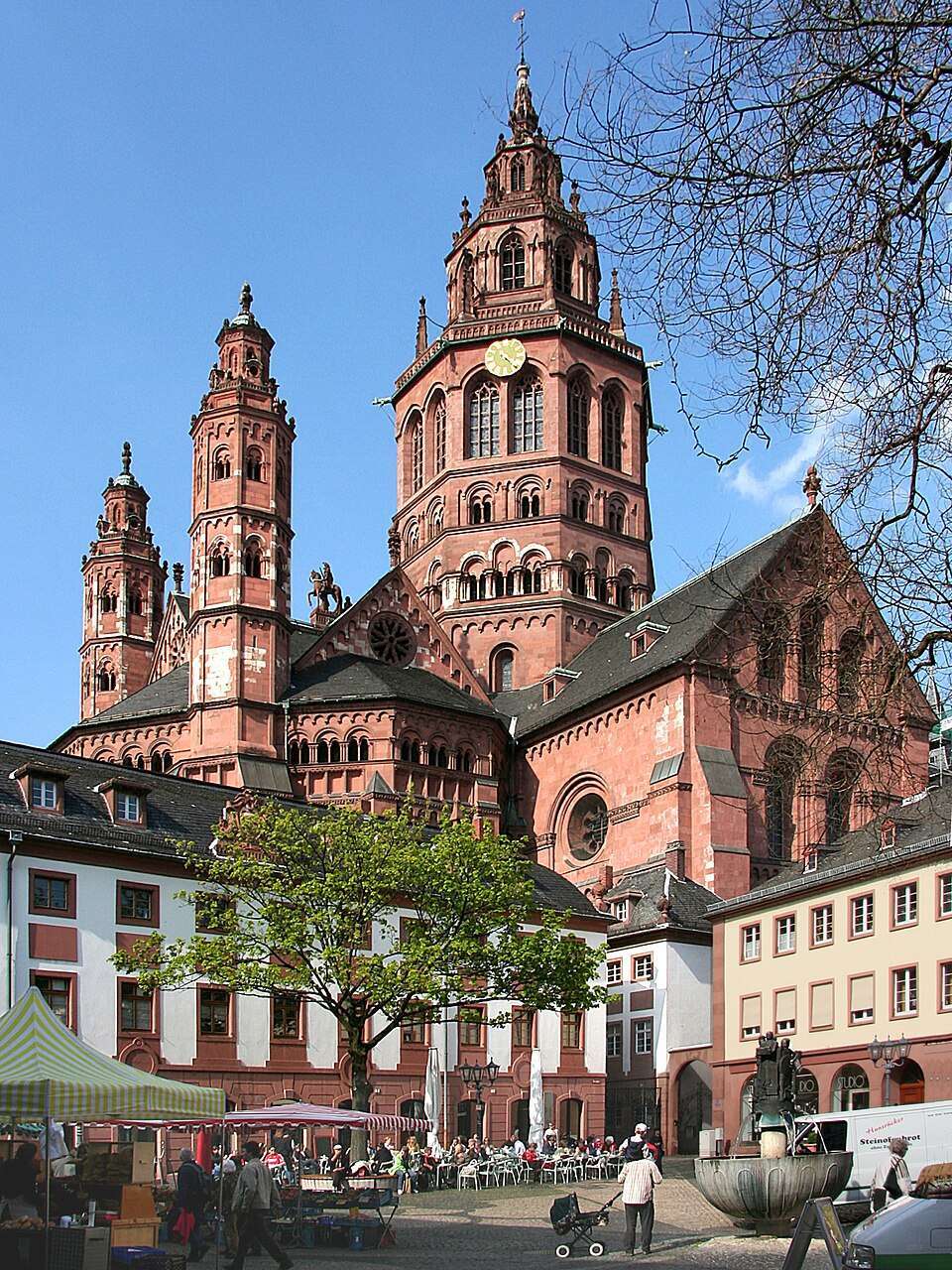
Forty minutes southwest, Mainz is Gutenberg’s city, and the Gutenberg Museum is the reason: two original 42-line Bibles in the vault and the working replica press where demonstrations still pull inked pages the way the fifteenth century did. The cathedral — a thousand years of Romanesque bulk in red sandstone — and the Marc Chagall windows in St. Stephan’s, blue enough to read as underwater light, complete the essential trio.
The rest of Mainz: the Kirschgarten’s half-timbered corner, the Saturday market on the cathedral square with its institutionalized wine stand — the Marktfrühstück, where the town drinks Riesling at 10 a.m. among the vegetables and considers it civic duty — and the Roman-Germanic museums for the deep-history inclined.
Wiesbaden, across the river and fifteen minutes on, is the counterpoint: the nineteenth-century spa capital where Dostoevsky gambled away the money that became The Gambler, at a Kurhaus casino still operating under chandeliers. The Nerobergbahn — the water-ballast funicular, an engineering charmer — climbs to the city view, and the Kaiser-Friedrich-Therme runs the full historic bathhouse ritual. One city per half day; the pair makes a leisurely full one.
Read the full Mainz day-trip page.
Würzburg — The Residence and the Riesling
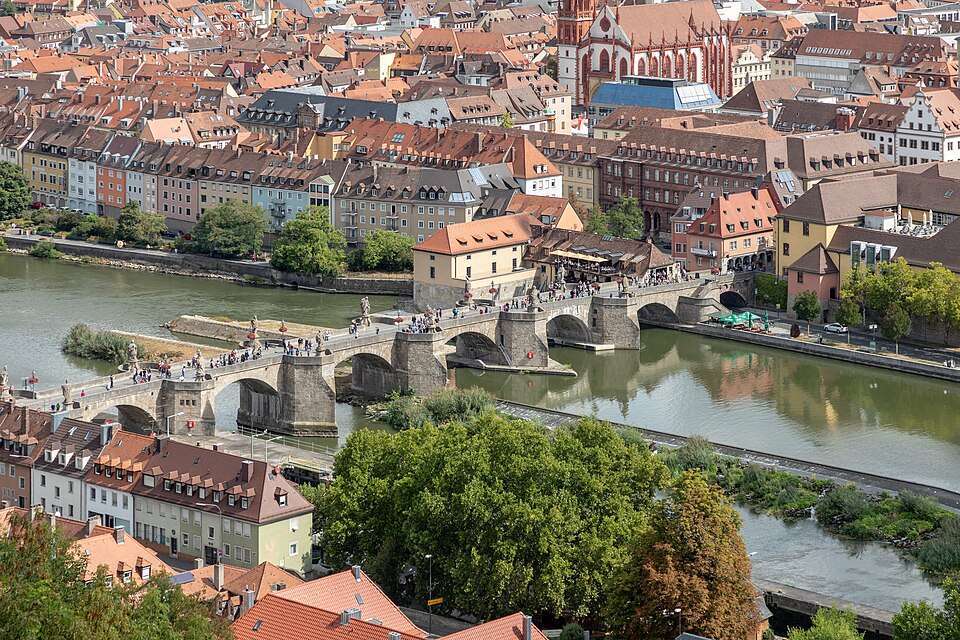
Seventy minutes east by fast train, Würzburg anchors the Romantic Road’s northern end with a single overwhelming building: the Residenz, the prince-bishops’ palace, UNESCO-listed for the staircase hall where Tiepolo painted the largest ceiling fresco on earth — the four continents swirling around Apollo, surviving the 1945 firestorm because Balthasar Neumann’s vault held when the roof burned above it.
Open daily (9 to 6 April–October, shorter in winter), with English tours at 11 and 3 included in the ticket, under-18s free, and online tickets skipping the desk queue. The Hofkirche and the gardens complete the visit at no extra charge.
The town around it: the Alte Mainbrücke, where the Brückenschoppen ritual — a glass of Franconian Silvaner drunk standing on the bridge among the saints’ statues — is the city’s signature hour; the Marienberg Fortress across the river for the vineyard-framed view; and the Bürgerspital and Juliusspital wine estates, charitable foundations that have funded care with wine for six centuries, pouring the Bocksbeutel’s flattened-flask tradition at the source. The Residenz plus the bridge is a half day of the highest quality; the wine makes it linger to a full one.
Read the full Würzburg day-trip page.
Rothenburg — The Honest Verdict
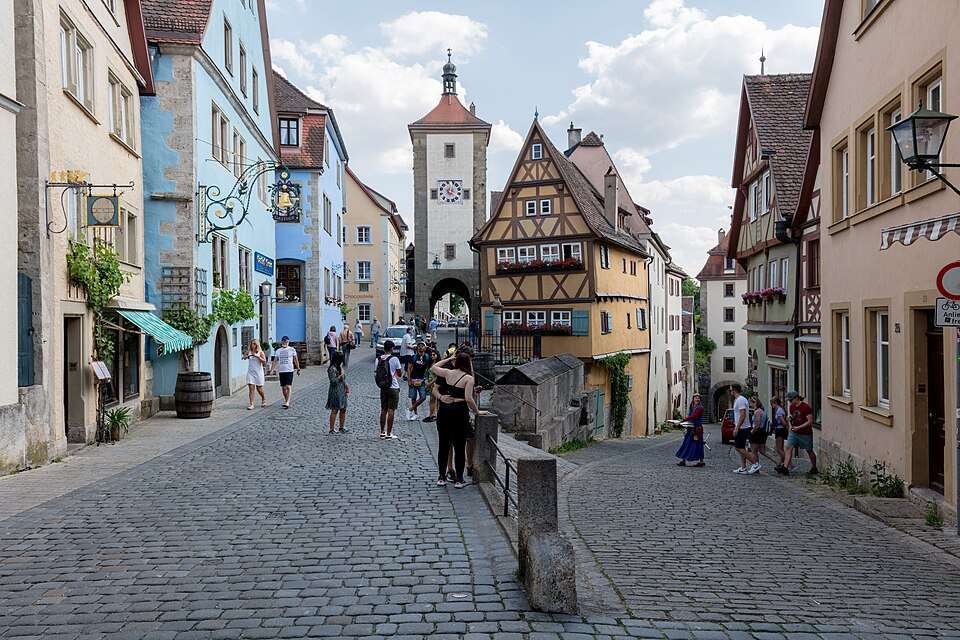
Rothenburg ob der Tauber, the walled medieval town every brochure prints, sits two and a half to three hours from Frankfurt with train changes — which makes the math six hours of transit around a town whose walkable core asks three or four. It’s done daily, mostly by coach tours, and the result is the town at its worst: midday, at maximum density, between coach waves.
The verdict: go, but go smart. The overnight is the transformation — the Night Watchman’s tour at dusk (English, theatrical, and good), the walls walked at dawn before the day-trippers land, and the town briefly returned to itself. Day-trippers who can’t move the night should target shoulder season, arrive early, and walk the wall circuit first while the lanes are clear.
What justifies it: the Plönlein corner (yes, the one from every calendar), the walkable town walls, St. Jakob’s Riemenschneider altarpiece — the carved Holy Blood retable that is the town’s actual masterpiece — and the Medieval Crime Museum’s cheerfully grim collection. The Schneeballen pastry is the local dare: a fried dough ball rated fairly as better to photograph than to finish. December’s Reiterlesmarkt is the town at maximum Christmas and maximum crowd, chosen deliberately or avoided entirely.
Read the full Rothenburg ob der Tauber day-trip page.
The Römer Question, the Museum Bank & Frankfurt Itself
The rebuilt old town first: the Römerberg’s half-timbered row and the Neue Altstadt behind it are reconstructions — the originals burned in 1944, the rebuild finished in 2018 — and the question “is it real?” has an honest answer: it’s real craftsmanship on real medieval floor plans, and the city is candid about which stones are old. Taken on those terms, the quarter between the Römer and the cathedral is a genuine pleasure; taken as untouched history, it was never claiming that. The Kaiserdom’s tower climb adds the overview.
The Museumsufer — the museum embankment — is the heavyweight row: the Städel’s seven-century collection (the Holbein-to-Richter run is top-tier in Europe), the Film Museum, the Architecture Museum, and the Liebieghaus sculptures, with the Saturday flea market along the bank as the free layer. Across town, the Palmengarten’s glasshouses and the Main Tower’s 200-meter public platform cover the green hour and the skyline one.
The apple wine rules, because Sachsenhausen’s Ebbelwoi taverns run on them: it arrives in the ribbed glass from the blue-grey Bembel jug, it tastes sour and dry by design — the first glass is a negotiation, the third is a conviction — and asking for it sweetened marks you gently. Order the Handkäs mit Musik (the onions are the music) and the Grüne Soße, the seven-herb sauce the city treats as identity. Season math: spring and fall are the windows, the trade fairs reprice hotels without warning year-round — check the Messe calendar before booking anything — and the Christmas market on the Römerberg is the rebuilt quarter at its most convincing.
Frequently Asked Questions
What’s the best day trip from Frankfurt?
Heidelberg — under an hour to the castle ruin, the Great Tun, the old bridge, and the Philosophers’ Walk view. The €11 ticket bundles the funicular, courtyard, and Pharmacy Museum; interiors go by guided tour only.
Is Rothenburg doable as a day trip from Frankfurt?
Barely — two and a half to three hours each way with changes, landing you in the midday coach crush. It works with an early start in shoulder season; the better answer is the overnight with the Night Watchman’s tour and dawn walls.
What’s worth seeing in Würzburg?
The Residenz — Tiepolo’s ceiling over Neumann’s staircase, the largest fresco on earth, with English tours at 11 and 3 and under-18s free. Add the bridge-wine ritual on the Alte Mainbrücke and the fortress view.
How does Frankfurt’s apple wine work?
It’s served sour and dry from the Bembel jug into ribbed glasses in Sachsenhausen’s taverns — the first glass is a shock, the third a habit. Pair it with Handkäs mit Musik and green sauce, and don’t ask for sweetener.
Is Frankfurt’s old town real?
It is a reconstruction — the originals burned in 1944, the rebuild finished in 2018 on the medieval floor plans, and the city says so plainly. Taken on those terms, the Römerberg-to-cathedral quarter is worth the hour.