The Grimms’ Marburg
An hour north to a hillside of half-timber, Germany’s first purely Gothic church, and the castle where Luther and Zwingli argued to a draw.
The short version
- Direct RE trains run Frankfurt–Marburg about hourly, taking roughly an hour and ten minutes — covered by the Deutschland-Ticket; times at bahn.de.
- The Elisabethkirche, begun 1235 over St Elisabeth’s tomb, counts as Germany’s first purely Gothic church — and her gilded shrine inside is one of medieval Europe’s great goldsmith works. Town info at marburg-tourismus.de.
- The Brothers Grimm studied here from 1802, collecting the tales that became the tales; the Grimm-Dich-Pfad scatters their characters — a giant’s boot, Cinderella’s slipper, the frog king — up the town’s staircases.
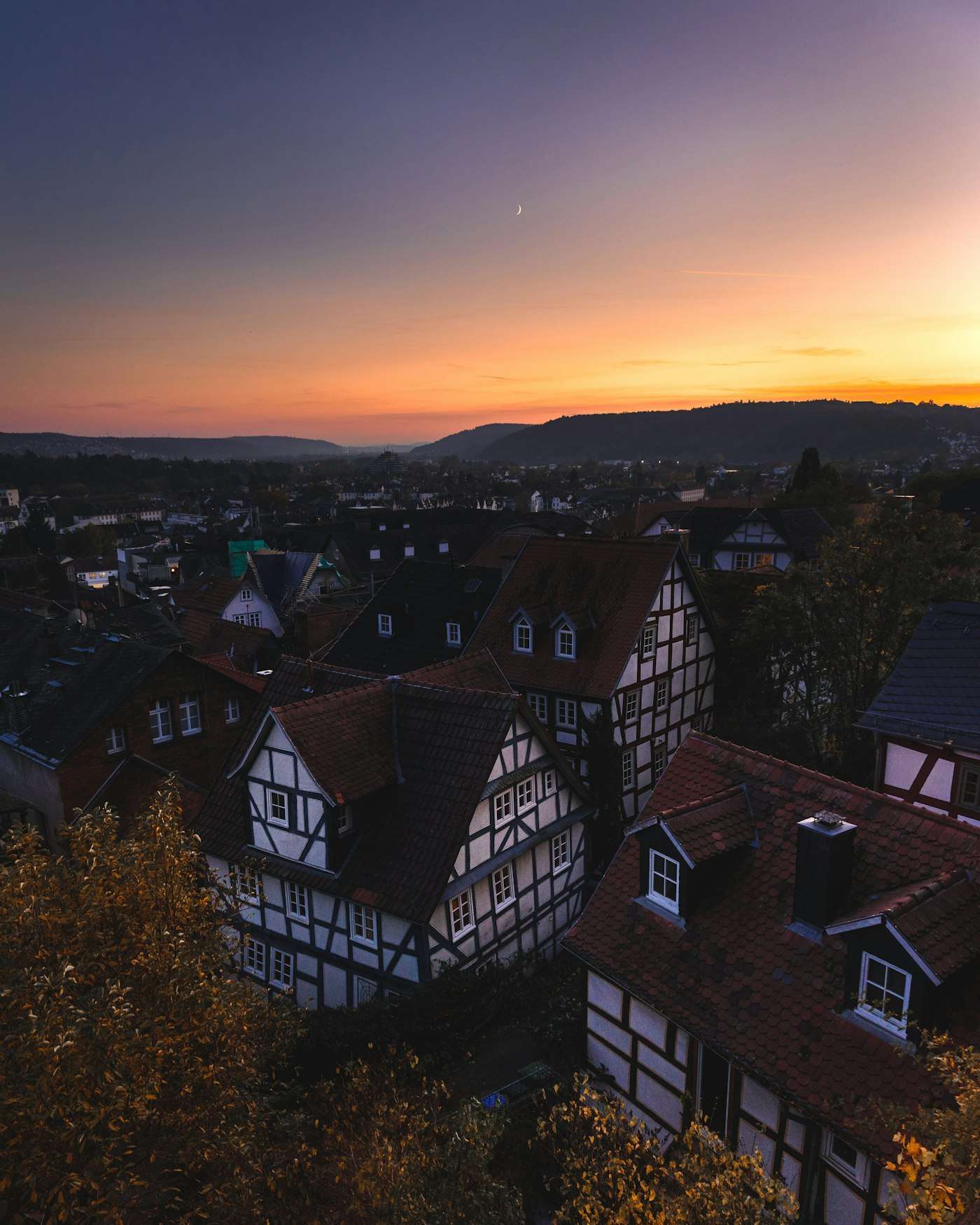
- The Oberstadt is the fairy tale made municipal: half-timbered lanes stacked on a hillside, connected by public elevators that save the steepest climbs.
- The Landgrafenschloss crowns everything — the castle where Luther and Zwingli held their 1529 Marburg Colloquy and agreed on fourteen points of fifteen. The view over the Lahn valley settles any remaining arguments.

Getting there
Regional express trains leave Frankfurt Hauptbahnhof for Marburg about hourly and take roughly 70 minutes up the Lahn valley, all covered by the Deutschland-Ticket. From Marburg’s station, cross the Lahn toward the Elisabethkirche — ten minutes on foot — then work upward: the Oberstadt’s public elevators (free) lift you to the upper town, and the castle path climbs from there. Drivers take the A5 and B3 in about an hour; parking lives at the bottom of a town best experienced going down.
The day
Start at the Elisabethkirche while the light is low: Germany’s earliest all-Gothic church, raised by the Teutonic Order over the tomb of Elisabeth of Hungary — the princess who chose poverty and the sick, died at 24, and drew all medieval Europe here on pilgrimage. Her golden shrine survived the Reformation and glows in the sacristy. Then ride the elevators into the Oberstadt and let the Grimm trail organize the wandering — the brothers studied law here and left with folklore instead, and the town has planted their imagery from the frog king by the fountain to the giant boots on the stairs. The Marktplatz’s Rathaus releases a trumpeting rooster on the hour. Climb last to the Landgrafenschloss: the 1529 colloquy room where Luther and Zwingli agreed on everything but the Eucharist, the museum, and the long view over red roofs to the Lahn hills. Descend by the lanes you missed, coffee where the students do — one in five Marburgers is one — and roll downhill to the evening train.
When to go
Year-round: the town is its own weatherproof exhibit, and university terms keep it lively outside summer. December’s Christmas market climbs the Oberstadt photogenically; spring and autumn give the Lahn valley walks their color. Summer weekends draw Frankfurt day-trippers, but Marburg absorbs them the way it absorbs freshers — noisily and without lasting harm.
Frequently Asked Questions
How do you get from Frankfurt to Marburg?
Direct regional express, about hourly, roughly 70 minutes, covered by the Deutschland-Ticket. The Elisabethkirche is ten minutes’ walk from the station; elevators lift you to the upper town.
What is the Grimm connection?
Jacob and Wilhelm Grimm studied law at Marburg’s university from 1802, where a professor turned them toward old German folk material — the detour that produced the fairy tales. The Grimm-Dich-Pfad trail plants their characters through the town’s lanes and stairs.
Why does the Elisabethkirche matter?
Begun in 1235, it is held to be the first purely Gothic church on German soil, built over the tomb of St Elisabeth of Hungary. Her gilded shrine remains inside, and the church made Marburg one of medieval Europe’s major pilgrimage stops.
What happened at the castle?
The Marburg Colloquy, 1529: Philip of Hesse brought Luther and Zwingli together to unify the Reformation. They agreed on fourteen points and split permanently on the fifteenth — the Eucharist — a fork in Protestant history that happened in a room you can stand in.
How steep is Marburg really?
Genuinely steep — the old town climbs a castle hill in stacked lanes and staircases. Free public elevators handle the worst ascent to the Oberstadt; comfortable shoes handle the rest. Jacob Grimm claimed there were more stairs in the streets than in the houses, and he was right.