Mainz from Frankfurt: Check the Gutenberg Museum’s Status, the Chagall Blue, and a Thousand-Year Cathedral
Forty minutes up the Rhine, the town where printing began — check what the Gutenberg Museum is showing before you build the day around it, then take the Chagall windows and the thousand-year cathedral, which move for no renovation.
The short version
- S-Bahn and regional trains run Frankfurt to Mainz in 35–45 minutes at commuter fares and constant frequency (bahn.de), with the old town a ten-minute walk or short tram from the Hauptbahnhof.
- The Gutenberg headline carries the alarm’s standing hedge: Johannes Gutenberg printed the 42-line Bible here around 1455 and changed everything; his museum — holder of two original Gutenberg Bibles — is mid-rebuild, its collection showing in interim arrangements, and the what’s-showing-where check (gutenberg-museum.de) precedes committing the day to it.
- The press demonstrations survive the works per the alarm: the museum’s Druckladen print shop runs hands-on demonstrations of movable type and the hand press — ink, frisket, and the pull that started mass literacy — on its own reliable schedule.
- St. Stephan’s is the alarm’s blue: Marc Chagall glazed the choir windows in his final years (1978 onward) — the only German church with his glass, made as a reconciliation gesture by the Jewish artist for a German church — and the light inside runs the deep blue the alarm calls weather.
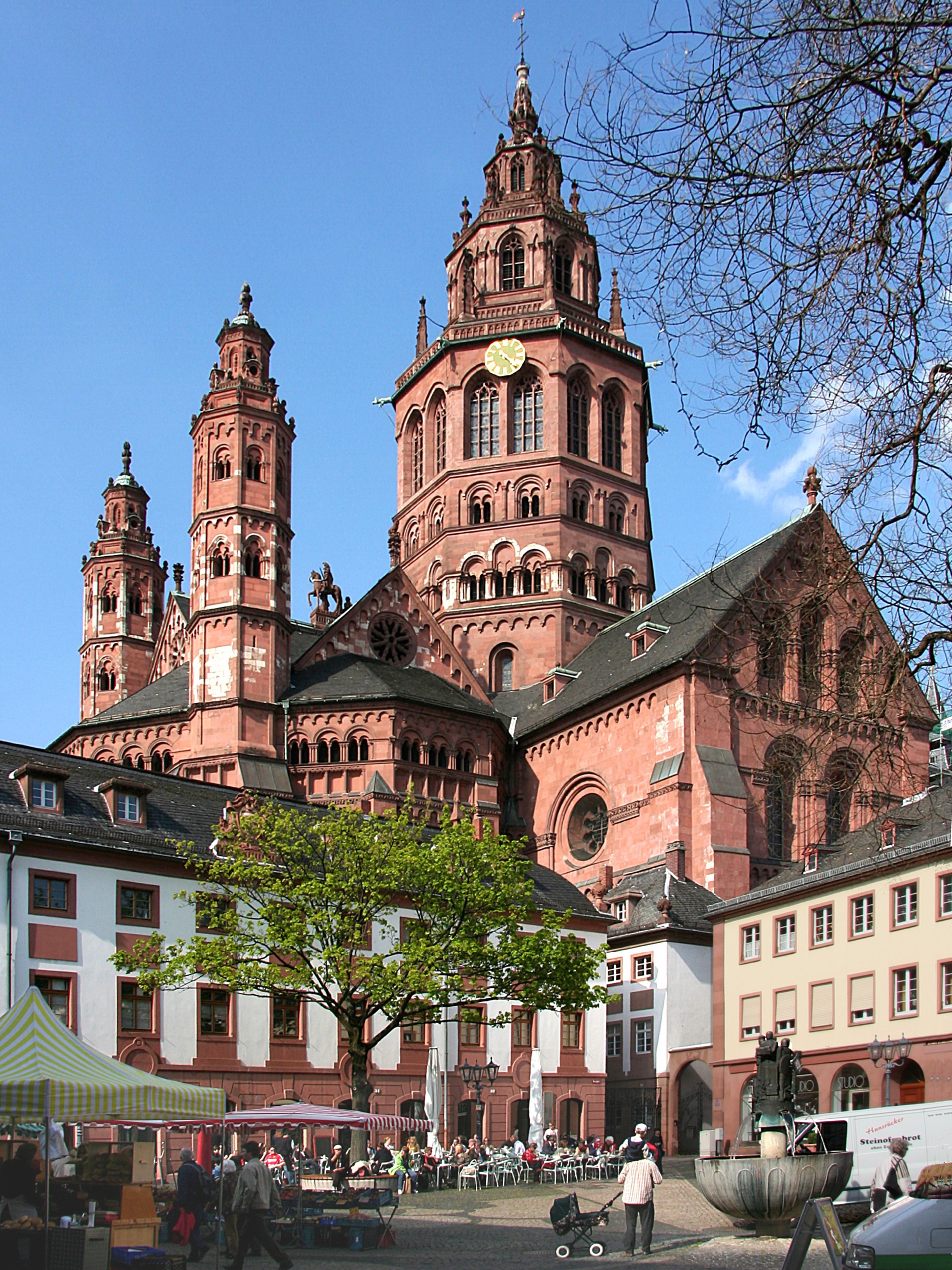
- The cathedral holds the deep layer: a Romanesque giant consecrated over a thousand years ago, coronation church of the Holy Roman archchancellors, its red sandstone bulk anchoring the Domplatz and its interior stacked with archbishops’ monuments.
- The town rounds it at Rhenish register: Saturday’s Domplatz market with wine stands among the produce per the alarm (Rheinhessen is Germany’s largest wine region and pours accordingly), the Kirschgarten’s half-timbered corner, the Rhine promenade, and a carnival tradition ranking with Cologne’s and Düsseldorf’s in the pre-Lenten weeks.

Getting there
The S-Bahn’s constant service makes Mainz a whim from Frankfurt — the alarm’s without-thinking clause is the actual logistics. The one planning act is the museum status check: the rebuild has moved the collection’s public face between interim homes, and knowing the day’s target address (and the Druckladen’s demo times) before boarding converts uncertainty into a clean loop. Saturday visits build around the market’s morning peak; carnival-season visits accept that the fools hold the town.
The day
Open with whatever the Gutenberg check returned: the Bibles viewed wherever they currently hang — two of the surviving originals, their pages’ black density explaining five centuries in one look — and the Druckladen’s demonstration for the physical half: type set backward, ink beaten, the platen’s pull, and a printed sheet that makes the revolution mechanical and obvious. The cathedral takes the pre-lunch hour: the nave’s Romanesque mass, the archbishops’ monuments read like a stone chronicle, the cloister’s quiet. Market Saturdays insert themselves here with wine-stand logic per the alarm. St. Stephan’s climbs the small hill for the afternoon’s stillest twenty minutes: Chagall’s blues shifting with the clouds, the reconciliation story told by the glass itself. The Kirschgarten’s half-timber corner and the Rhine promenade walk the remainder, with a Rheinhessen glass at the water as the correct close. The S-Bahn home runs until late without caring.
When to go
Year-round per the glance — churches and museum are all-weather, and Saturday is the market’s standing argument in every season. Late February–March brings Mainz’s carnival at full institutional force: Rosenmontag’s parade takes the town, which is either the reason to come or the reason to date around it. Summer adds the Johannisnacht festival (midsummer, honoring Gutenberg with printing traditions among the stages) and the Rhine terraces; Advent dresses the Domplatz market under the cathedral’s bulk.
Frequently Asked Questions
What’s the museum rebuild situation?
The Gutenberg Museum’s home is undergoing a long-planned full rebuild, with the collection’s highlights — the Bibles first — shown in interim quarters and the Druckladen print shop running through the works. Status, addresses, and hours move as phases complete, which is the alarm’s whole check-first instruction: the substance is intact; only the map changes.
Why are the Chagall windows a big deal?
Chagall was in his nineties and had never glazed a German church — St. Stephan’s pastor corresponded with him for years, and the artist made the choir windows as an explicit gesture of Jewish-German reconciliation, completing designs until his death in 1985 (his studio finished the cycle). The blue light inside is the argument no summary carries; the story is why it exists.
Is the cathedral free?
Entry is free or donation-based on standard hours outside services — a thousand-year Romanesque interior at the best admission price in the region. The treasury-museum layer tickets separately for the committed. Sunday mornings are the liturgy’s; visitors work around it as guests.
What should I know about the market?
Saturday mornings (with smaller midweek days) fill the Domplatz with Rheinhessen producers — and the wine stands among the vegetables per the alarm are a genuine local institution: a glass of riesling at 11 a.m. among the flower buyers is Mainz behaving normally. It winds down by early afternoon; go before noon.
Mainz or the Rhine Valley from Frankfurt?
The Rhine Valley loop (documented on this network with its train-boat-train shape) for castles and river spectacle as the full-day epic; Mainz for printing, Chagall, and market life at S-Bahn distance. The honest pairing: Mainz as the half-day city hit, the gorge as the committed day — the same river, two entirely different registers.